
This blog is selected as 1/3 for summative assessment.
This animatic workshop explores typographic pre-sets, transitions, alpha channels and the use of solids and vectors, combining such to create a consistent, powerful and thorough infographic outcome.
References provided above inspired animatic ideas, specifically with regards to the creation of an infographic video. In specific, the strategy of how to layout information in a way which can be relayed to and translated by an audience, easily and legibly, reformed one of my key points of focus when watching the above examples.
Additionally, I noticed how the stylistic nature alters the overall visual effect, which can be achieved through considered colour use, and through the general nature of illustrative and typographic content. Context, as well as desired message, must be a vision of focus when making such stylistic decisions, to ensure that the outcome matches the intentional inferred transcription from a viewers perspective. For example, if addressing environmental stability, a bold, yet respectful, stance must be adhered too, reducing any risk of viewers taking offence or feeling general discomfort, while instead portraying a strong, clear message.
I particularly like the way in which the information is relayed to suit the visual identity throughout the progress of the videos, maintaining focus while keeping the audience concentrated. Additionally, the informative content is unveiled in fun and relevant ways, maintaining viewer attention.
Provided theme of infographic: Green.
Associations with – positivity, freshness, the art of keeping an open mind, being open to new opportunities, nature and delicacy, beauty, health, and success. Additionally, our conditioned mindset subconsciously makes a direct link with the traffic light system, portraying green as a symbol of positivity.
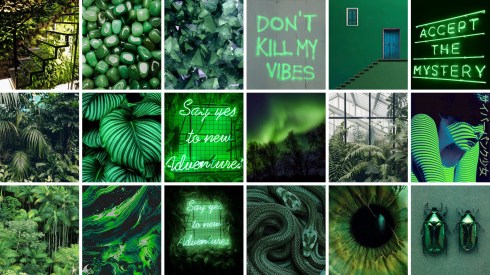
A mood-board constructed to visualise ideas and inspire project direction. A level of diversity can be noticed throughout the subject, portraying a reflection of the vast area of investigation.
Colour theory subjects a potential direction of study, where I intend to investigate the effect the colour has upon our thoughts and feelings throughout everyday life.
Contextual Research:
““Color impacts the brain because it can greatly affect our physiology, since it influences anxiety, pulse, blood flow and arousal,” Brain Based Biz, a branding blog reported.”
“Color psychology suggests that different colors can evoke psychological reactions … Perhaps because green is so heavily associated with nature, it is often described as a refreshing and tranquil color.”
“Psychologists have found that green can increase creativity. They’ve also found that green is associated with complex thinking and higher-level thought as well as relaxation, inward focus, and calm actions … When we think of green, we think of nature and growth, so it’s not surprising that we assimilate those feelings toward ourselves by associating green with our own personal or professional growth.”
“Green evokes a feeling of abundance and is associated with refreshment and peace, rest and security … Green helps people feel rested and secure … Green encourages a balance in your brain that leads to decisiveness.”
Reflection: The colour green has substantial benefits within our psychological nature, encouraging positive movements. It is a creative colour, and therefore improves productivity, stimulating the human brain. It is recognised to reflect the idea of growth, while promoting positive and relaxing thought processes.
Potential infographic subject: “5 reasons you should incorporate GREEN into your everyday life.”, or “Ok, listen, GREEN is a creative colour, and here is why.”
- Green will significantly improve productivity, promoting a natural sense of growth.
- Green psychologically improves mental health, relaxing the brain and reducing anxiety.
- Promotes refreshment and inner peace.
- Implements a subconscious link with nature, aiding thoughts of tranquility.
- Refines focus and calmly encourages more direct and decisive thought process.
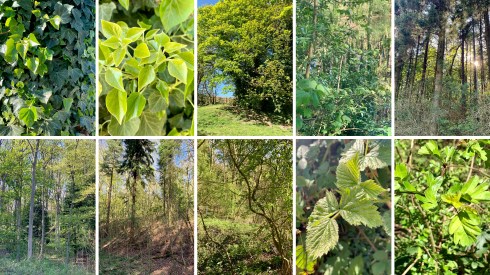
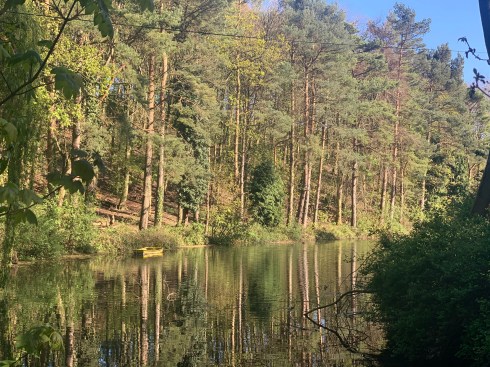
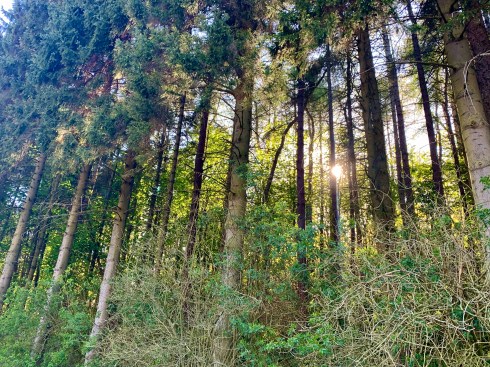
Primary research: Next I ventured into the woodland to become immersed in nature, fuelling creative productivity. Surrounded by greenery, I especially took significant notice of the psychological effect my surroundings had upon my mood. Emersing each of my senses I felt an overwhelming sense of tranquility, suddenly relaxed with a clearer mindset.
Typographic consideration:
Since the video duration requirement is of a concise 10 seconds, it is critical that the written content is easily legible so that it can be translated easily, reducing any wasted time. The typed content needs to be concise and to the point to maintain focus and interest, so that the factual information doesn’t consume all the viewers attention, ie – other graphic aspects need to be noticed and appreciated.
For this reason, a bold, yet simplistic type-face would be most suitable for use in this video, fit for purpose.
Additionally, the ideology and connotations of the colour green are associable with clean thinking, and simplistic form; unnecessary over-complication must be avoided in order to achieve best results.
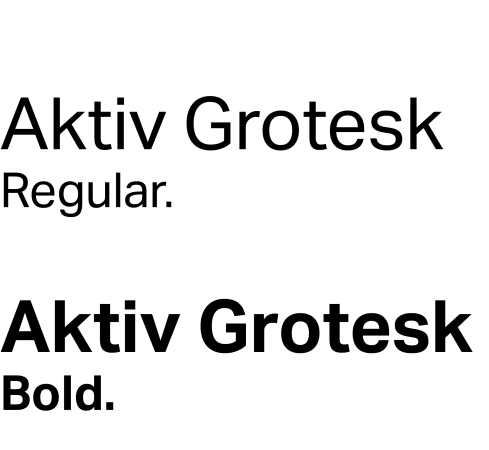
I explored 5 different simplistic fonts, comparing how they would look when used to display relevant information, see below.



Documented here is a poster I playfully created to explore the effect of different font style variations, as well as composition. I like the tonal gradient of green bands, combined with the minimalist Swiss-inspired style. I feel that this simplistic approach better suits the nature and connotations of green as a colour. For this reason a similar aesthetic and visual style will be applied to my animatic video, ensuring a similar nature is transcribed by any audience/ viewer.
The Making of my Video:


Here, are some of the visuals I have created for use in my infographic video, linking the colour green with the subject of nature. A leaf and a tree have been created with the same skeleton shape so that a transition can be adopted, where one will become the other, to create an interesting connection, displayed in a cleverly constructed visual method.
I intended to keep the graphic content/ visuals simple, so that it does not overwhelm the screen, avoiding any accidental distraction to the typographic aspects of the video.
I also recorded a video capturing the sounds of nature, such as the tweeting of birds, movement of water and the rustling of branches/ leaves, to use in my video.
My outcome:
Here, I brought all elements together to create an animated infographic, providing information about the colour green. Using my research, I have simplified the facts to a minimal, yet bold and memorable form. I have considered colour theory and general connotations to ensure that my outcome provides an accurate translation of the nature of my subject – green. For instance, I have used simplistic form and typographic stylisation to focus audience attention on the facts, as well as the simplicity of the design, where this provides a message in itself. One of ‘green’s’ associations, is the art of mastering a clear, controlled and focussed headspace, and so I have tried to echo such within my animation.
See an insight of my working document below:

A series of different visual effects have been explored and utilised, especially investigating pre-sets offered by Adobe After Effects. I applied typographic pre-set effects to reveal the characters/ words gradually at reading pace, which successfully minimalists the intensity of written content on the screen at one time. This improves the legibility factor, while improving general flow of the video.


On my visual, illustrative content, I used the pre-set effects of block dissolve and CC line wipe, which again, served to make the video progress smoothly, where content would appear and disappear in one constant movement.


The use of these pre-sets saves time when animating, while entailing for a close to perfect result to be generated almost straight away. Flexibility is still available, where timeframe, intensity, direction, etc, can be adjusted to suit your individual project.
To finish up this particular project, a wipe was created to create a blank end-frame. This was created on a separate composition, before being imported into the main comp. Use of a wipe allowed for the video to feature as part of a collaborative show-reel, feeding into the next video smoothly and generatively. To create this wipe, I used the layer effect pre-set CC line wipe on a solid. The use of an alpha channel was also adhered too in order to maintain transparency, especially necessary in the end of the video, after the wipe transition.
 K.Hughes Graphics