
The movement of post-modernism rejects modernistic values, including unity, harmony and optimism, and instead serves to question conventional beliefs instead. A deliberate motive to disregard cultural origins and instead reform a new, rational approach was applied amongst design theory and reiterated across new media products and publications. Post-modernism defies truth and meaning through public stance, in order to inflict altered perception upon consumers of the media, globally.
Inferred meaning surrounding the term ‘post-modern’ reflects an unrestricted mentality and mind-set of being free to wilful expressionism beyond judgement, where a sense of personal reality is often referenced, or otherwise serves as a key motive in production. This beyond-modernistic stance is known to present recognition of a distorted truth, and question specific values brought about through previous corruption. The notion of this prompted design to adapt a more playful and experimental approach, challenging possibilities.
“The New Discourse” is a term utilised to present a rise of cultural ideas spread diversely across multiple disciplines. This was supported by the revolution of technology, and the implementation of such widespread globally. This made media, and design, accessible to a greater audience, and entailed for the collaboration of culture and beliefs.


Cranbrooke Academy of Art practised the potentials fuelled by The New Discourse, with much of their work revolving around typographic discourse. This playful techniques forces the viewer to attempt at making sense of meaning behind the image, constructed to contradict social expectations. For this reason, the interpreter will become engaged with the visual, serving as a participant.
Roland Barthes unveiled the concept of ‘readerly’ and ‘writerly’, with reflection of visual, artistic, and literature movements. Readerly refers to a state within which the author controls the message, incorporating intentional representation to impose a desired singular meaning. Writerly however, presents the idea that the reader constructs the meaning behind the text, obtaining a constructivist approach inferring multiple meanings. This inflicts a more thought-provoking sense and actively involves the viewer within the image. Meaning can differ based upon personal experience, cultural values, personal stance and values.
Cranbrook Academy of Art recognised the potentials withheld Barthes’ concept, projecting this by deconstructing meaning through the feature of deliberate typographic fragmentation. The effect of numerous interpretations enlightens a shared sense of cultural embracement, generating multiple ideas surrounding the specific outcome. This evokes public attention, and in turn, causes question of traditions, values and truths echoed through society.
Cranbrook Academy of Art had influence upon the idea of typographic representation, that text can portray message beyond its literal meaning. A strive for plurally was noticed within this time period, where it was recognised as a post-modern asset that the world and the meaning of its traditional values, are very much subjective qualities. It was recognised to be a movement into acceptance, where objective framework transitioned towards subjective, where personal implementation became increasingly valued and normalised through self-expression and interpretation; a massive change within the operation of society.
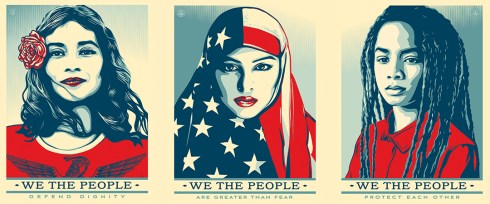
Shepard Fairey, We The People, 2017
Shepard Fairey produced these recent works as part of a recent campaign to embrace culture and protest Americas recently elected government, Donald Trump. These outcomes work to embrace diversity and “defend dignity’, projecting a sense of clarity upon the values of modern society. Provoking deliberate question, Fairey intents to collaborate differentiated identity with community, to ultimately induce strength through undermining conventions and expectations. He presents a selection of participants amongst multi-cultural backgrounds through symbolistic values of America’s associated iconography; the American flag. Fairey uses this presentation to infer a message that it doesn’t matter what culture, religion, place of birth, gender, age, or personal identity a person has, as a citizen of America they should be welcomed and embraced within a society.
Overview of this work, and Fairey’s drive, leads to the emergence of an obvious theme of authenticity; a question of morals. Beyond this, analysis and shared recognition of purpose led to the question of why we are so desperately trying to embrace cultural diversity. Is it for recognition presented through publicity? Or because we want to bring change to build a less-restrictive and more humane nature? With regards to initial motive, it can be vastly noticed that social media has brought greater insight and acceptance with regards to personal differences, fuelled by a greater acknowledgement of reputation, where it is considered more important to be recognised as open minded, non-discriminative and non-judgemental. This embracement of diversity has been manufactured through consumption within our media-led digital world, questioning the operation of society and treatment of personal values within it.


Hate and Power can be a Terrible Thing, 2004 by Tracey Emin features a quilting plaque stitched with controversial, opinionated statements. This was a notion of self-experssion, where Tracey Emil recognised the nature of post-modernism and its potential of publicity. Her works commonly feature themes of emotion and sexuality based on experience and self-exposure. Implementation of unconventional content and less-desirable assets leads to the question of values within a society, as well as serving as an expression of feelings. Engaging the viewer with a sense of shock, or in some cases relatability, Emin deliberately features such strong, compelling messages to captivate attention and gain publicity. An obtained knowledge that publicity drives change fuels her motive.
Let them eat Crack, 2008 by Banksy draws upon a theme of leadership corruption, metaphorically referencing a statement by Marie Antoinette’s “let them eat cake”. This refers to a state of poverty within which many families struggled to afford bread. “Let them eat cake” was Antoinette’s response, signalling ignorance through a significant lack of understanding towards the rich/poor divide. Banksy’s statement here signifies hierarchy, questioning the treatment of lower-class, vulnerable citizens and the demoralisation that occurs with this. The general message is suggestive that we cannot escape the judgements of the world within which we live in, utilising metaphors to apply symbolic values to a society.
The above works of Banksy and Tracey Emil are each examples of how post-modern values can be applied to, proving how the movement maintains relevance today. Achieved through a question of values, both of the works present expression and morals relevant to familiar movements and expectations within our society. An awareness of audience is clearly implemented, forcing the viewer to culturally interpret the images and construct meaning based upon experience. Therefore, the audience becomes a participant, fully engaged with the scope of message inferred by the artist/ designer.
 K.Hughes Graphics