
Surrealism dates back to the 20th century, being a term that describes a movement in art and literature, based predominantly upon the unconscious mind.
Psychologist Sigmund Freud’s ‘iceberg’ theory forms a key foundation to surrealist thinking and beliefs. This theory concentrates on the process of unconscious thinking and state of mind.
“The preconscious contains thoughts and feelings that a person is not currently aware of, but which can easily be brought to consciousness… The preconscious is like a mental waiting room, in which thoughts remain until they ‘succeed in attracting the eye of the conscious'” Freud, 1924
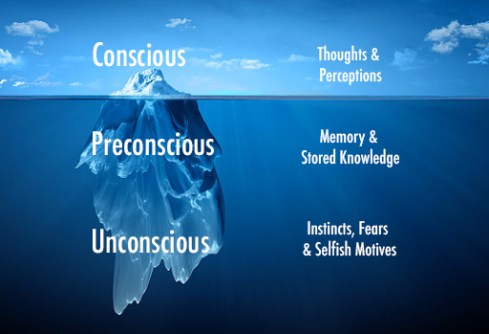
The above statement refines a psychological notion supporting the theory of thought process, and the way in which the mind operates. This concept is then implemented into design process in the form of surrealist values; an abstract art form created by non-direct thinking methods.
Described by Andre Breton, surrealism is defined to be “pure psychic automatism”. This presents the idea that creative outcomes can be constructed based upon venture into the unconscious mind, entailing for less thinking and more doing to take place. This set a theme, providing correlation in the direction of work produced under the surrealist movement.
An experimental approach was obtained within this surrealist period, in the form of numerous techniques. This includes collage, cubomania, decalcomania, fumage, outagraphy, exquisite corpse, and reface.
The use of collage entails for increased freedom and expression utilising external, second-hand sources. This provides greater scope in terms of subject and content, and therefore, leads to a vast range of collage work to be produced, all unique and original formulated through the use of layering.
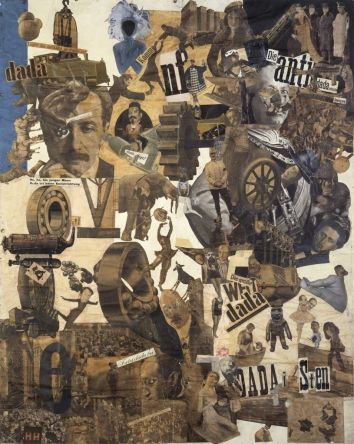
An example of a collage artist from the surrealist movement is Hannah Hotch, who was a pivotal artist from Germany. She produced “Cut with the Dada Kitchen Knife…” to project a clear statement surrounding sexism and racism within Germany of that era, using newspaper clippings from a relevant magazine. This in itself sends a message, inducing more depth to the message Hotch aimed to transcribe.
Sammy Slabbinck, a contemporary collage artist, makes clear reference of this movement within her recent works. This proves that the movement has been influential and has had an impact on the way in which design is created, even today. See works below.

Slabbinck’s work utilises not only technique, but reflects key themes relevant in 20th century, Surrealist nature. This is where her work prompts thought, tied contextually with ideas present across multiple generations, where the principles surrounding such ideologies have more recently been reevaluated and assessed. For example, Slabbinck uses collage material that regularly features explicit reference to the objectification of woman.


This is a deliberate choice to project correlated ideas, now up for question in a more contemporary, advanced society. The decision to feature such imagery was originally an aspect of second nature, used to draw attributes of desire into the artwork in order to gain publicity. The period of surrealism marked a time in history where it was completely normal and conventional to use explicit imagery so freely; an aspect of subconscious thinking.
In more recent times, the way in which female figures are portrayed through the media has been questioned against increased levels of respect. It is now recognised that woman maintain the same importance within as society as male figures, where this was not the case in historical times. In our contemporary society, the feature of woman in an objective or suggestive nature is now utilised for a different reason, to induce shock and reminisce such obscene trends and ideologies of previous societies.
Cubomania is another example of a surrealist movement, being a more specific asset of collaging. This process resolves around the breaking down and reassembly of an image, based upon geometric shapes, usually squares. This entails for particular freedom of expression in an otherwise restrictive nature. Similar themes are present to those seen in surrealist collage.
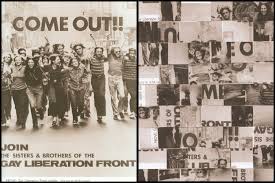
This methodology has inspired contemporary graphic design; collaborations of images are brought together in a geometrically enhancing layout, improving the visual qualities of any specific design, fit for purpose. Reminiscing cubomania, alternate geometric entities have been explored in recent design, with the intent of bettering impact and organisation. For instance, triangles are often seen amongst various layouts, to present multiple images collectively. This portrays a modern sense, heightening visual qualities. Examples below.


The term ‘Decalcomania’ presents another experimental, surrealist approach, based upon a symmetric technique involving a liquid based medium being pressed between a canvas to create a mirrored image. This strategy of working was demonstrated by Cornelia Parker in 1996, titled “Pornographic Drawing”.

“To make these works, Parker acquired pornographic videotapes and extracted the ferric oxide component from the film, suspending it in a solvent to form a liquid and applying it to sheets of white wove paper. She then folded each piece of paper down its centre so that the ferric oxide ink printed itself on both sides, creating a mirror image, after which she unfolded and flattened out the paper.”
Parker describes her works to be a result of her subconscious, leaving outcomes open to interpretation with no true meaning as such.
Fumage is a technique popularised by Wolfgang Paalen, involving impressions made by smoke from a candle on paper or canvas around the time of the surrealist movement. Outcomes are semi-abstract, entailing for open interpretation, and heightened depth of potential message. Steven Spazuk is a contemporary artist utilising a similar methodology within his work. Examples of Wolfgang Paalen’s and Steven Spazuk’s works presented below.


Outagraphy is a process resolving around the removal of an images focal point to create a whole new outlook for an image. This idea was initially introduced by Ted Joans proposing deliberate alteration in focal point, and with this, a subconscious abstract running deep into the mental placement of the creative individual.

Exquisite Corpse defies a process within which a singular individual initiates a drawing or sentence, before folding it over and passing it on to the next person. This process is repeated multiple times before being unfolded to reveal a ‘random’ and abstract visual collaboration of ideas, each originating from ones personal unconscious mind. The nature of this idea proved shocking, creating mash-ups of shocking qualities, as well as small aspects of personality.

 K.Hughes Graphics