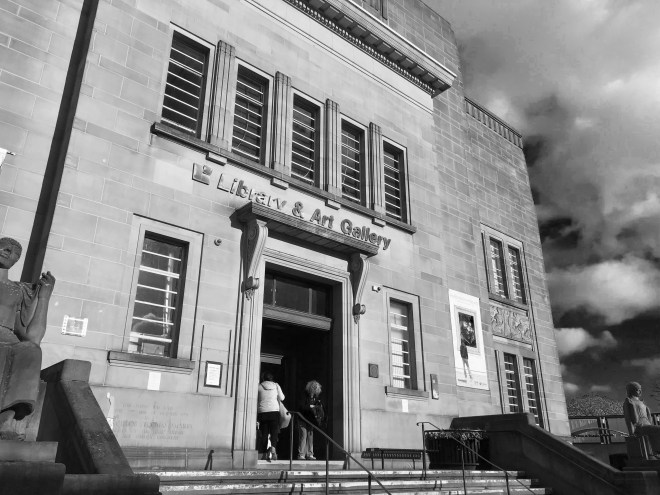
14/11/2018 – Visit to Huddersfield’s Art Gallery, with the intent of enriching my personal sense of place. A small gallery, however a selection of the work links directly with the nature of the small town.

A historical painting, produced with oil on canvas, documents Huddersfield in its industrial timeframe. Stretched into the distance, the landscape is lined with chimneys connected with factories, illustrating the peak of industrial movement.
L.S. Lowry was famous for travelling around, observing and capturing working-class scenes, often featuring correlated aspects of terraced houses, factories, smoking chimneys, and crowds of people. This was due to a personal fascination, especially with Huddersfield which Lowry would return too time after time. This was due to the poorer status of the town, which contained less manufactured frontage; Huddersfield served to be a functional pace, as opposed to a polished and glorified social hub. With this, life in the town was reduced down to its essential elements, where the ways of living were classic and traditional, in some ways, inducing a stronger sense of community between residents.
This transcription captured by Lowry documents the view of Chapel Hill looking towards Lockwood, commissioned by Huddersfield Borough Council in 1965. The painting features conventional assets notorious amongst Lowry’s work, being a classic industrial landscape with all the ingredients that initially made him famous.

Fascinated by contrast seen between the natural and man-made world, much of Peter Brook’s works feature landscapes with aspects from each of these entities, displaying some form of interaction. Often the implementation of water is captured, displaying reflections, movement and fluidity.
In this case, Brook illustrates the natural movement of water beneath a local mill, displaying elegance and peace through the creation, or reflection, of a relaxed atmosphere. It is obvious that this sense derives through personal, close observation, entailing Brook to analytically depict values and senses within the landscapes nature.
Subject of his visual outcomes often featured mills. However, as the industry fell to decline, Brook’s works became a symbol of industrial history; a record of a previous time-frame.


Liz K Miller, The Circular Scores, 2015.
Huddersfield’s art gallery contained a selection of Muller’s works from her Circular Scores exhibition. Not directly tied with Huddersfield, yet her work brought inspiration, displaying unconventional ways of working and visualising information. Her work is constructed in a linear form, collaborating themes of geometry, physicality, data visualisation, a knowledge surrounding spacial usage, with reference to the fluidity of natural sources. These circular designs have been constructed in response to the nature of sound, designed to be printed onto vinyl. Her intent was to captivate a sense of layering, texture, tone, repetition and rhythm in the circular form of a map. This is clearly noticeable following review of Miller’s etched outcomes.


Other works I particularly liked in Huddersfield’s art gallery are documented above. To the left is Construction, by Anthony Hill, and on the right is Yellow Brick Road by an unknown artist. Each of these images denotes the ability to compose space to utilise visual impact. This is achieved by the feature of contrast, and a deliberate sense of depth presented through opposed values of foreground and background content.
Anthony Hill’s works sought inspiration directly from the Dada movement and surrealism, before he later began to experiment with and embrace collage. His systematic drive originated from his interest with geometry, abstraction, formal order as well as the utilisation of contemporary mediums and techniques. Plastic and metal are prime examples here, as seen in Construction, constructed of aluminium and perspex.
Qualities recognised within works seen in Huddersfield’s art gallery reformed inspirations and influence with regards to the creation of personal works in my studio project. I intend to experiment with both analogue and digital ways of working to ultimately formulate a product of individuality and expression. The matters of symbolism, texture, stylisation, presentation, composition and the implementation of depth are also aspects I will consider on an increasingly focused level within my work.
 K.Hughes Graphics