A theory is defined as ‘an attempt to explain something’.
Communication design is a creative process that combines the visual arts and technology to communicate ideas. A message that transcends mere words and pictures.
Shannon & Weaver: Model of Communication

This model documents how a message is transmitted from a source along a channel to a receiver after passing through noise resulting in some loss of information.
Warren Weaver applied this model to more vast industries, following an interest of applying models from physical science to the understanding of human behaviour.
This design can be applied to the principles of design creation, where noise is just another term to denote a destruction or obstacle interviewing with the success of the final outcome. This model highlights a source of motive; to illuminate noise, ultimately bettering the final outcome.
Emmert/ Donaghy: Model of Communication

This model acknowledged that communication always occurs within context, including the communicators themselves, as well as physical, socio-cultural and technological environments through which the message passes. The effect of this means the original source may become distorted, in terms of both physicality and inferred translation. Consideration of this must be undertaken within the initiation period of any project.
The Importance of Semiotics
Alongside communicative models, and understanding of semiotics is also critical to obtain creative understanding.
“Semiotics” refer to the way within which signs and signifiers collaborate to induce meaning for an interpreter to extract from any piece of design, media, literature, or art form in general. It is important to consider semiotics to ensure that message is translated correctly to a selected audience. Semiotics utilise a shared knowledge of conventions across a society, chosen specifically by the designer to bring depth to the outcome. The embedding of semiotics into any form of creative outcome requires much creative thinking, consideration and precision to ensure the message is transcribed as accurately as possible, as intended.
Representation and Symbolism
“Representation” defines as a more direct signifier in design and media. For instance, for an idea to present that of another, shared aspects will be noticeably evident, by which an audience can draw a direct link between sources.
Symbolism as a concept presents this ideology, bringing immediate recognition. This is usually sought from logos and colours, often drawing from aspects familiar in every day life. The media is also massively responsible, where symbols and themes are broadcasted to mass audiences, bringing a shared understanding amongst numerous communities.
For example, the use of colour presents semiotics obtained through association. The use of red is often used to present negative aspects, while the use of green is usually selected to enforce a positive outlook. This is then implemented in, and subconsciously interpreted within symbolic assets. Examples to follow.
Red:


Green:



The Red Cross, Red Crescent, and Red Crystal can be described as outsiders in correlation to the above symbolic connotations. These symbols are used for medial purposes, often seen on the side of medical vehicles, recognised as a provider of assistance to the wounded, with no discrimination as to which side the soldier is on.
The colour red has been used here for its boldness, high visibility, and connotations of danger and ill-health, yet provides a positive motive.
The emblem initiated as the red cross, before the crescent was introduced not long after. Being subject of conversation for a long time, the third emblem was initiated. This is due to the lack of symbolic reference to culture or geographic origin, reforming an image more suggestive of a ‘middle-ground’. This was assumed to be safer, for both the assistants, and the soldiers.
Symbolism reforms a key attribute of design, utilising knowledge of connotation and denotation, semiotics and representation. Each of these aspects are analytically considered by designers when making subjective choices, with regards to specific intention of how the work should be read and interpreted by a modern-day, contextually informed audience.
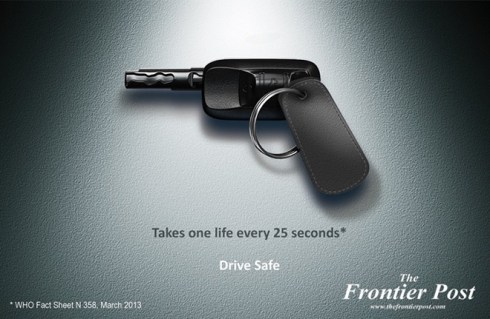
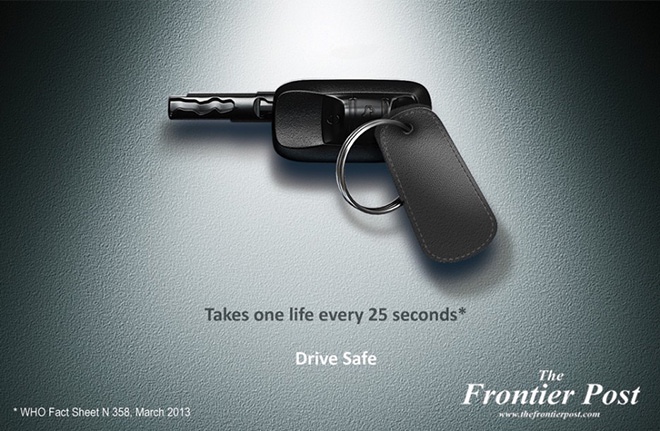
The image above presents a contemporary campaign targeting road safety. This has been cleverly presented by the designer, revealing an aim to induce deliberate reference to violence through gun crime; a more threatening subject. This is due to an obtained knowledge held by modern society of associated connotations surrounding guns, these being death, gore, and violence. Comparison to such a sincere entity strengthens the overall message projected through the campaign. Maintaining relevancy to the main subject, the shape of the gun has been recreated by car keys in a symbolic nature, immediately drawing a easily recognisable link for any audience to understand. This is a singular example of how symbolism is used in the design industry to prompt thought, add depth, and strengthen overall message.
 K.Hughes Graphics