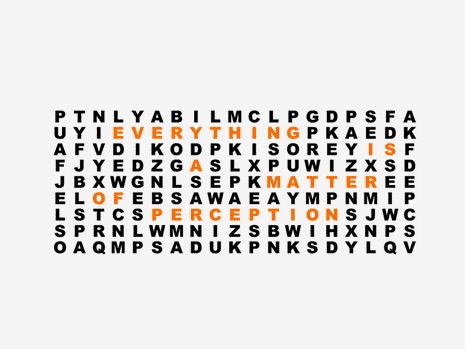
Perception
The term ‘perception’ denotes the way in which we interpret information, and how this is understood by the specific individual. It resolves around the brain making sense of information that the eyes provide, and organising this in a way which can be recognised. This is individual to everybody, shaped by your own past experiences, understandings and the way within which your mind operates. This process involves applying our knowledge of the world, including past experience, learned behaviour, memories, emotions, expectations and cultural influences.
Expectation reforms a key factor as to how we interpret content, yet is less recognised as an influence to altered perception. A direct link can be sought between what we expect to see and therefore what we look for, as well as the fact that what we do see, effects what we anticipate to see in future. This anticipation is directly responsible for the fact that we unknowingly filter information, directing and channeling our perception dependent upon what we want to see.
Depth perception is another key aspect when considering the connection between what we see and how our mind makes sense of this. The fact that we have two eyes, each receiving slightly different information, combined with our knowledge of dimensions, enables us to judge distance. This is a continuous scientific debate, as to whether the exploration of visual perception is innate, or learnt behaviour.
Alternating cultural experiences can also affect perception, where many cross-cultural studies found that a sense of perception is developed relevant to background and surrounding environment. For instance, familiarity with cityscapes provides more developed senses towards distance and movement, compared with people from different countries, only familiar with desert scares or jungles.
Illusion
The term ‘illusion’ is defined as ‘an instance of a wrong or misinterpreted perception of a sensory experience’. This is due to the fact that the human brain is trying to make sense of such deliberately confusing imagery and apply an obtained knowledge of the world to make sense of something that does not fit within such realistic boundaries. This can lead to a false perspective, making something appear in a way which it does not exist.
Presented below are some examples of famous illusions:


Following this lecture, I now understand how the origins of perception and illusion effect our individual interpretations, and the effect this can have when reviewing certain imagery.
 K.Hughes Graphics